: either of two large semiaquatic herbivorous rodents comprising a family (Castoridae including Castor canadensis of North America and C. fiber of Eurasia), having webbed hind feet and a broad flat scaly tail, and constructing dams and partially submerged lodges
Verb
he's been beavering away at the various courses for his dinner party all day long, hoping to impress his new friends
Recent Examples on the Web
Examples are automatically compiled from online sources to
show current usage.Read More
Opinions expressed in the examples do not represent those of Merriam-Webster or its editors.
Send us feedback.
Noun
In fact, a Texas jury once found that an alligator mascot infringed the beaver, so nobody should assume a judge shares their sense of the ridiculous.—
Roger Dooley,
Forbes.com,
7 Aug. 2026 With an ecosystem as capricious as this, the local wildlife is born and bred to go with the flow—think gentle-but-giant humpback whales, colonies of industrious beavers, and torpedoing peregrine falcons, the fastest animals on Earth.—
Kat Chen,
Condé Nast Traveler,
7 Aug. 2026 On July 26, a 13-year-old boy was bitten by a rabid beaver at Cunningham Falls State Park's William Houck area near the North Beach of the lake.—
Adam Thompson,
CBS News,
6 Aug. 2026 One euthanized beaver tested positive for rabies, officials said.—
Bill Hutchinson,
ABC News,
6 Aug. 2026 See All Example Sentences for beaver
Word History
Etymology
Noun (1)
Middle English bever, from Old English beofor; akin to Old High German bibar beaver, and probably to Old English brūn brown — more at brown
Noun (2)
Middle English baviere, from Middle French
First Known Use
Noun (1)
before the 12th century, in the meaning defined at sense 1a
: a large plant-eating rodent that has webbed hind feet and a broad flat tail and that builds dams and houses of mud and branches which are partly underwater
2
: the fur of a beaver
beaver
2 of 2noun
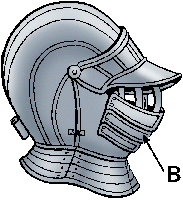
: a piece of armor protecting the lower part of the face


 Copy Citation