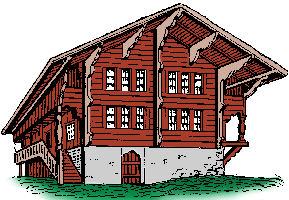
We stayed overnight at a ski chalet.
a mountain chalet for weekend getaways
Recent Examples on the Web
Examples are automatically compiled from online sources to
show current usage.Read More
Opinions expressed in the examples do not represent those of Merriam-Webster or its editors.
Send us feedback.
Designed by the Swiss practice Bayrou Architects, this 5,000-square-foot multi-level chalet sits on a sunny half-acre lot in the always spectacular Alps.—
Catherine Dunwoody,
Forbes.com,
1 Aug. 2026 Once a meager coffee plantation, now an eco lodge consisting of eight chalets on stilts.—
Condé Nast,
Condé Nast Traveler,
27 July 2026 The former Duchess of York, 66, has allegedly been living at her ex-boyfriend Paddy McNally’s chalet in Verbier, Switzerland.—
Juliana Ukiomogbe,
InStyle,
24 July 2026 The chalet was designed by Jean Gagnier and evokes the cozy feelings of alpine living—from the outdoor fire pit to the steamy on-site hot tub.—
Audrey Lee,
Architectural Digest,
23 July 2026 See All Example Sentences for chalet
Word History
Etymology
borrowed from French, borrowed from Franco-Provençal of Switzerland (and adjacent Alpine regions of France and Italy) tsalẹ̀, tchalè "cabin in upland summer pastures used as a residence and for processing milk into butter and cheese, pasture in the vicinity of such a structure," from tsal-, tchal-, stem probably meaning "shelter" seen as an underived noun in Old Occitan cala "cove, inlet" (also in Spanish & Catalan, and as a loanword from Spanish in Italian & Portuguese, probably a borrowing from a western Mediterranean substratal language) + -ẹ̀, -è-et entry 1
Note:
A display of the variants found in Franco-Provençal of Switzerland can be seen in Glossaire des patois de la Suisse romande (tome 3, p. 270). The word occurs as chaletus in Latin documents from present-day Vaud canton beginning in the fourteenth century. As chalet the word is first attested in metropolitan French in 1723; it received wide circulation through its use in Jean-Jacques Rousseau's novel Julie ou la Nouvelle Héloïse (1761).


 Copy Citation