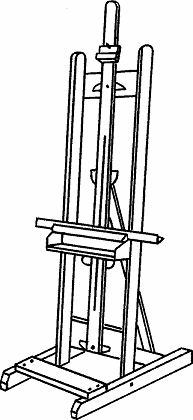
: a frame for supporting something (such as an artist's canvas)
Illustration of easel
Examples of easel in a Sentence
Recent Examples on the Web
Examples are automatically compiled from online sources to
show current usage.Read More
Opinions expressed in the examples do not represent those of Merriam-Webster or its editors.
Send us feedback.
Bring your own materials but easels, tables, chairs and drawing horses are provided.—
Hema Sivanandam,
Mercury News,
3 Aug. 2026 For Round 2, Sam brings in artists Kiana, Lisa, and Caldwell, and sets them up with easels.—
Tasha Robinson,
Vulture,
28 July 2026 The ocean-facing solarium was not only a bit of architectural derring-do by Goldman but also one of Mitchell’s creative spaces; photographs by Henry Diltz show her painting at an easel beside the glass doors that open to the beachside pool and spa.—
Mark David,
Robb Report,
23 July 2026 Eventually, the couple broke protocol through their email and social media announcement ahead of the typical easel announcement.—
Rachel Burchfield,
InStyle,
22 July 2026 See All Example Sentences for easel
Word History
Etymology
borrowed from Dutch ezel, literally, "donkey," going back to Middle Dutch esel, going back to Germanic *asil- (whence Old Saxon & Old High German esil "donkey," Old English esol, eosol, Gothic asilus), altered from Latin asinus — more at ass entry 1
: a frame for supporting something (as an artist's canvas)
Etymology
from Dutch ezel "a frame to hold an artist's canvas," literally, "donkey"
Word Origin
An easel is a frame for holding up such things as an artist's painting or a chalkboard. In the 17th century the Dutch had become famous throughout Europe for their oil painting. Thus it was their word ezel, which they used to refer to this piece of equipment, that was borrowed into English around that time. This sense of ezel was an extension of the original meaning "donkey," probably because an easel, like a beast of burden, is used to hold things.


 Copy Citation