: any of a class (Insecta) of arthropods (such as bugs or bees) with well-defined head, thorax, and abdomen, only three pairs of legs, and typically one or two pairs of wings
b
: any of numerous small invertebrate animals (such as spiders or centipedes) that are more or less obviously segmented—not used technically
2
: a trivial or contemptible person
insectadjective
Illustration of insect
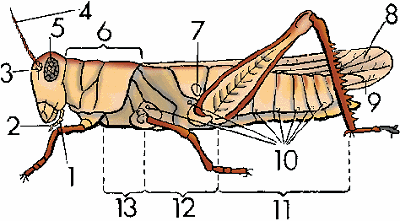
1 labial palpus
2 maxillary palpus
3 simple eye
4 antenna
5 compound eye
6 prothorax
7 tympanum
8 wing
9 ovipositor
10 spiracles
11 abdomen
12 metathorax
13 mesothorax
Did you know?
The bodies of insects have segments, or divisions, so they appear to have a series of notches cut into them. This led the Greek philosopher Aristotle to give insects the name entomon “a thing cut into.” Entomon comes from the prefix en- “in,” combined with the verb temnein “to cut.” Later, when the Romans wanted a word for this kind of creature, they did not simply borrow the Greek word. Instead they translated it with the Latin word insectum, from the verb insecare “to cut into.” Insectum was borrowed into English as insect.
a swarm of flying insects
the magazine's editor in chief was notorious for treating staffers as insects, often not even bothering to learn their names
Recent Examples on the Web
Examples are automatically compiled from online sources to
show current usage.Read More
Opinions expressed in the examples do not represent those of Merriam-Webster or its editors.
Send us feedback.
Companion planting with flowering plants, like yarrow, zinnias, and sunflowers, attracts beneficial insects that naturally control pests.—
Lauren Landers,
The Spruce,
4 Aug. 2026 This can be due to landscaping or construction damage as well as diseases or insects.—
Molly Burford,
Southern Living,
4 Aug. 2026 Mysterious working Curiously, the exact mechanism behind why these eco-friendly quantum dots scare off insects remains a mystery, even to their creator.—
Mrigakshi Dixit,
Interesting Engineering,
4 Aug. 2026 Indeed, snuffing out that insect’s life may have strengthened her sense of belonging.—
Dan Piepenbring,
Harpers Magazine,
4 Aug. 2026 See All Example Sentences for insect
Word History
Etymology
Latin insectum, from neuter of insectus, past participle of insecare to cut into, from in- + secare to cut — more at saw
: any of numerous small invertebrate animals (as spiders or centipedes) that are more or less obviously made up of segments—not used technically
2
: any of a class of arthropods (as butterflies, true bugs, two-winged flies, bees, and grasshoppers) with the body clearly divided into a head, thorax, and abdomen, with three pairs of jointed legs, and usually with one or two pairs of wings
Etymology
from Latin insectum "insect," derived from insecare "to cut into," from in- "in" and secare "to cut" — related to dissect, section
Word Origin
The bodies of insects have segments, or divisions. Thus they seem to have a series of notches cut into them. This appearance led the Greek philosopher Aristotle to give insects the name entomon "a thing cut into." Entomon comes from the prefix en- "in," combined with the verb temnein "to cut." Later, when the Romans wanted a word for this kind of creature, they did not simply borrow the Greek word. Instead they translated it into the Latin word insectum, from the verb insecare "to cut into." Insectum was borrowed into English as insect.