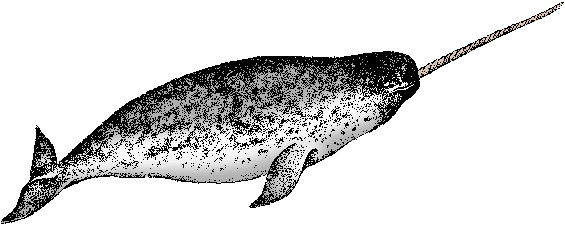
: an arctic cetacean (Monodon monoceros) that reaches a length of about 16 feet (5 meters) and possesses in the male one or rarely two long, spirally twisted, pointed tusks
Note:
Although the narwhal is classified as a toothed whale (suborder Odontoceti), it does not possess any teeth in its mouth.
Illustration of narwhal
Did you know?
The narwhal is a toothed whale found throughout arctic waters. Its Latin binomial, Monodon monoceros, is derived from the Greek words for "single-toothed" and "single-horned." Its English name (also sometimes spelled narwhale) comes from the Norwegian and Danish narvhal and the Swedish narval, words which are probably a modification of the Icelandic nárhvalur, which comes from the Old Norse nāhvalr. In Old Norse hvalr means "whale" and is akin to the Old English hwæl, the ancestor of the Modern English whale. The first element of nāhvalr is believed to be nār, the Old Norse word for "corpse," from the resemblance of the animal's color to that of a human corpse.
Examples of narwhal in a Sentence
Recent Examples on the Web
Examples are automatically compiled from online sources to
show current usage.Read More
Opinions expressed in the examples do not represent those of Merriam-Webster or its editors.
Send us feedback.
The presence of several million nerve endings suggests that narwhals may be able to sense temperature or salinity changes in the water with their tusks.—
Jennifer Ouellette,
ArsTechnica,
18 Aug. 2026 View gallery - 3 images The narwhal's defining feature – its continuously growing tusk – is the only straight structure of its kind seen in nature.—New Atlas,
18 Aug. 2026 Now researchers are using advanced imaging technology to look at the narwhal’s tusk in unprecedented detail—studying it in the hope of unraveling some of its mysteries.—
Jackie Flynn Mogensen,
Scientific American,
18 Aug. 2026 The only other living species part of that family is the narwhal, which also inhabits the Arctic Ocean.—
Pat Mueller,
USA Today,
20 July 2026 See All Example Sentences for narwhal
Word History
Etymology
Norwegian & Danish narhval & Swedish narval, probably modification of Icelandic nárhvalur, from Old Norse nāhvalr, from nār corpse + hvalr whale; from its color